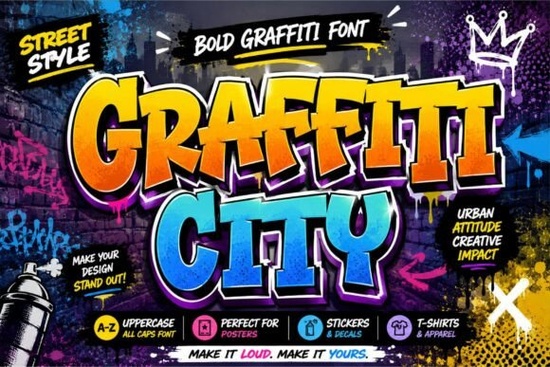
If you're looking for a bold, expressive font that brings instant street energy to posters, t-shirts, stickers, or social media graphics, Graffiti City Font is a solid choice. It’s not just another “graffiti-style” font it’s built with intentional chunky shapes, sharp angles, and confident spacing that holds up well at large sizes and in print. Designers who’ve used it say it reads clearly even when scaled down on product mockups, and it pairs surprisingly well with cleaner sans-serifs for contrast.
What kind of projects does Graffiti City work best for?
This font shines where personality matters more than formality. Think: limited-run apparel drops, local event posters, indie band merch, gaming stream overlays, or small-batch packaging for urban-themed products. Because it’s a display font not meant for body text it’s ideal for headlines, logos, and short phrases. You’ll see it used most often in contexts where the message needs to feel energetic, unapologetic, and grounded in real-world street culture not cartoonish or overly stylized.
It’s especially popular among print-on-demand sellers who want something distinct from overused script fonts or generic sans-serifs. One seller told us they tested three graffiti-inspired fonts side-by-side on mockup thumbnails and Graffiti City consistently got the highest click-through rate on Etsy listings for skate-themed hoodies.
How does it compare to other bold display fonts?
Unlike some heavy-handed graffiti fonts that rely too much on random drips or exaggerated swashes, Graffiti City keeps its structure legible and balanced. Its letterforms have consistent weight distribution and open counters so “A”, “e”, and “o” stay readable even in tight spaces like sticker borders or app icons. That makes it more versatile than flashier alternatives that look great big but fall apart at smaller sizes.
If you like the attitude of Graffiti City but want something slightly more industrial or architectural, Brick Edgie offers a different kind of urban texture think exposed brick walls and hand-painted signage. For travel or transit-themed designs, Departure Board gives clean, functional energy with a vintage terminal vibe. And if your project leans more toward emotional storytelling or community-focused branding, Homegoing brings warmth and rhythm without sacrificing visual strength.
What file formats and features come with it?
The download includes OTF and TTF files, plus a handy PDF guide showing recommended pairings and spacing tips. There are no extra ligatures or alternate characters just one straightforward, well-hinted font family. That simplicity means less time troubleshooting in Canva, Cricut Design Space, or Adobe apps. It also loads reliably in web-based tools, which helps if you’re designing mockups for clients or listing previews on Redbubble or Teespring.
No need to install anything fancy: drag and drop into most design software, and it works right away. Some users report smoother rendering in Silhouette Studio compared to similar fonts especially when cutting vinyl for custom signs or decals.
Does it work well with other fonts?
Yes especially with neutral, geometric sans-serifs (like Montserrat, Inter, or Poppins) or sturdy slab-serifs (like Courier Prime or Roboto Slab). Avoid pairing it with other decorative fonts unless you’re going for deliberate contrast like using Graffiti City for a headline and Brick Edgie for a subheading. Overloading with multiple display fonts tends to dilute impact rather than enhance it.
For color use, keep backgrounds simple: white, black, or muted tones let the font’s shape and weight do the talking. Bright neon fills can work but test them on actual fabric or paper first. What looks vibrant on screen doesn’t always translate to dye-sublimation or screen printing.
Who’s using Graffiti City right now?
A few real examples: a Pittsburgh-based muralist uses it for workshop flyers; a Toronto sticker shop layers it over grainy photo textures for their “Neighbourhood Heroes” series; and a small podcast about city life uses it for episode title cards always in all-caps, with generous letter-spacing. These aren’t edge-case experiments they’re practical, repeatable uses by people who need reliable results, not just novelty.
It’s not designed for corporate annual reports or legal disclaimers. But if your goal is to make something feel alive, local, and human-made this font supports that intention without getting in the way.
Before you download: Check your software compatibility first some older versions of CorelDRAW or free graphic tools may not recognize newer OpenType features. Also, remember that display fonts like Graffiti City are licensed for personal and commercial use, including POD, but not for resale as standalone font files or web font hosting.
- Test it at 3–4 different sizes before finalizing layouts
- Try it in black on white, then white on black see which feels stronger for your use case
- Avoid stretching or skewing the font it’s designed to sit naturally
- Pair it with one supporting font only, unless you’re intentionally building layered typography
- Save a version of your file with outlines (in Illustrator) or flattened layers (in Canva) before sending to print
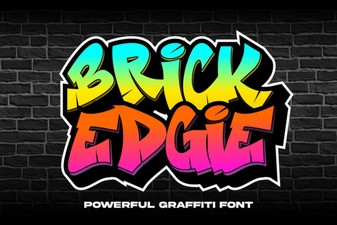 Brick Fonts: Building Unique Edgie Designs
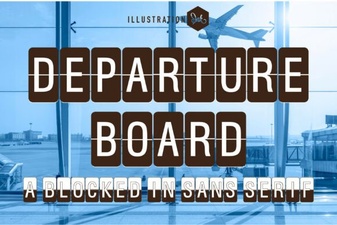 Choosing and Using Departure Board Fonts for Designs
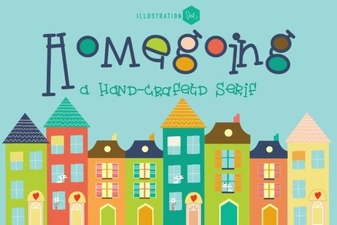 Designing with the Homegoing Font: Tips and Ideas
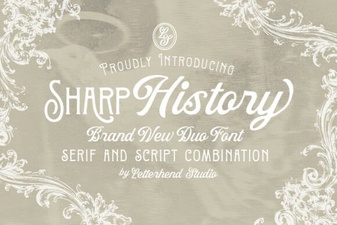 Designing Modern Websites with Sharp History Font
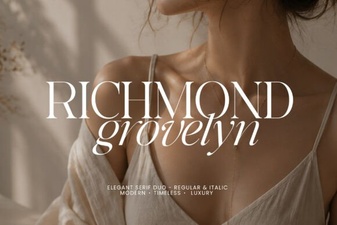 Craft Beautiful Projects with Grovelyn Font Style
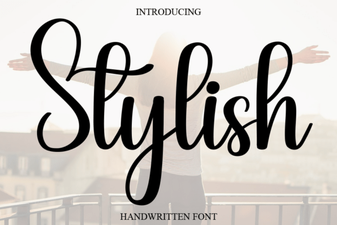 Fresh Font Designs for Modern Projects